
一、Why do we need sound-absorbing panels?
Have you ever found yourself unable to concentrate in a meeting room due to the distant sound of keyboards and interwoven echoes? Or when watching TV in a newly renovated open-plan living room, do you always feel the sound is muffled and the conversations unclear? Or do you feel fatigued by the surrounding noise of conversations while dining in a restaurant?
These noises don’t just come from the outside; more often, they’re caused by indoor echoes and reverberation. Studies show that over 60% of office workers have difficulty concentrating due to office noise; in public places like restaurants, excessively long reverberation times can even affect customers’ dining experience.
Today, we’ll talk about how to bring an unprecedented level of tranquility to your home, office, and commercial spaces through scientific design (sound-absorbing panels).
二、The principle behind sound-absorbing panels is that they do not “block” sound, but rather “absorb” sound.
Sound-absorbing panels are different from sound-insulating panels. Sound-insulating panels block sound (like a shield), while sound-absorbing panels absorb sound (like a sponge).
Sound-absorbing panels can absorb, convert, and dissipate sound wave energy, reducing echoes, reverberation, and noise reflections.
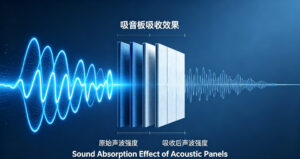
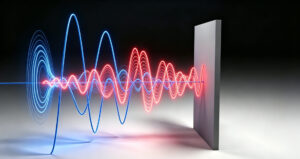
- Application scenarios of sound-absorbing panels
Scene 1: Enjoying tranquility at home – living room, bedroom, and home theater
In home decoration, wooden or polyester fiber sound-absorbing panels are commonly used. For most families who enjoy watching movies or listening to music at home, sound-absorbing panels can be installed on the feature wall or sofa wall. These effectively eliminate the “humming” sound caused by the TV/sound system bouncing between the hard floor and ceiling, providing a cinematic audio-visual experience. For bedrooms, studies, and children’s rooms, choosing environmentally friendly polyester fiber sound-absorbing panels can isolate external interference and ensure deep sleep.
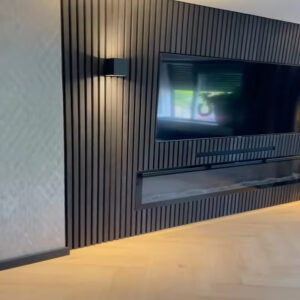
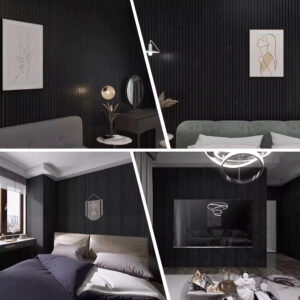
Scenario 2: Office and Business – Meeting Rooms and Open-Plan Office Area
Remote video conferencing is now a major part of modern office work. If the meeting room has too much echo, the other party will only hear reverberation. Installing sound-absorbing panels can not only reduce noise interference and improve the effectiveness of presentations and meetings, but also significantly improve speech clarity, avoiding auditory fatigue and decreased efficiency caused by prolonged exposure to noisy environments.
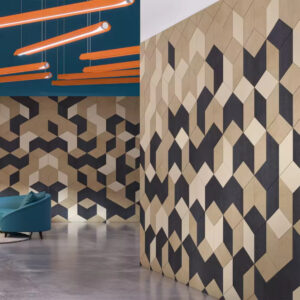
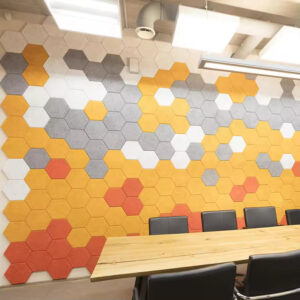
Scenario 3: Commercial Spaces – Restaurants, Hotels, and Cafes
Restaurants don’t need absolute silence, but they do need sufficient clarity for customers to converse easily. Using wood fiber panels or creatively designed geometric sound-absorbing islands in the ceiling area not only enhances the design but also significantly reduces reverberation time, elevating the space’s sophistication and increasing customer return rates. Especially in high-traffic areas like hotel lobbies and shopping malls, sound-absorbing panels solve noise problems while simultaneously enhancing the space’s aesthetic appeal.
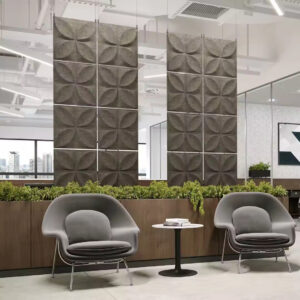
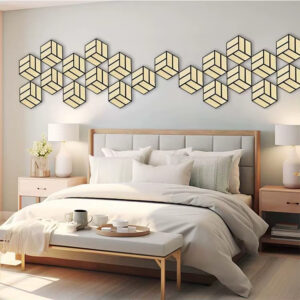
Scene 4: Professional Spaces – Recording Studios, Training Rooms, and Broadcast Halls
Recording studios, practice rooms, karaoke rooms, or large lecture halls have extremely high requirements for acoustic environment. These venues require professional grooved wood acoustic panels with high NRC (noise reduction coefficient, up to 1.0). These panels effectively control reverberation time, ensuring accurate capture of sound details and preventing sound distortion.


Acoustic panels are no longer just functional materials; they have become an integral part of spatial aesthetics. A good acoustic environment is a new kind of luxury, which can greatly enhance the quality of life, work efficiency, and artistic experience.