
Polyester Fiber Acoustic Panels: Flame-Retardant Fiber vs. Soaking Treatment
For hotels, offices, commercial buildings, conference rooms, schools and other architectural projects, polyester fiber acoustic panels are expected to provide both effective sound absorption and reliable fire performance.
When sourcing acoustic panels, buyers may encounter two common approaches to flame retardancy: flame-retardant fiber production and post-treatment through soaking or impregnation. Understanding how these two processes differ can help importers, distributors and project contractors evaluate products more effectively.
1. What Is Flame-Retardant Fiber?
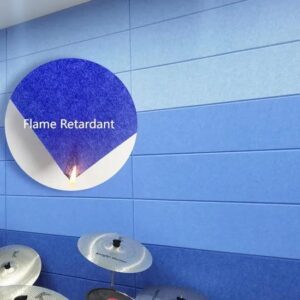
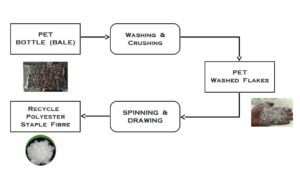
Flame-retardant fiber refers to polyester fibers manufactured with a flame-retardant system incorporated during the fiber production stage.
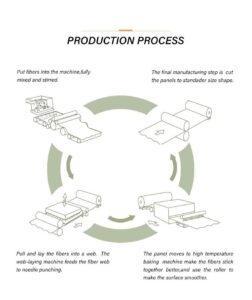
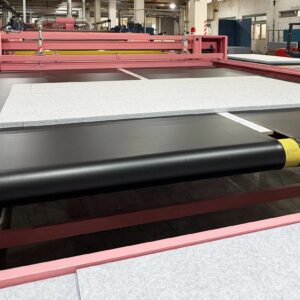
The flame-retardant polyester fibers are then processed into acoustic panels through opening, web forming, needle punching or thermal bonding, depending on the manufacturing process.
Because flame retardancy is addressed at the fiber-production stage, this approach integrates the fire-performance characteristics into the raw material itself. It is commonly considered for commercial and architectural applications where specific fire-performance requirements need to be met.
2. What Is Soaking / Impregnation Flame Retardancy?
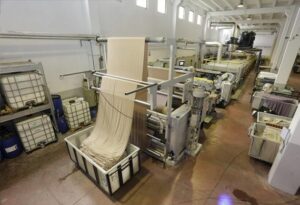
Soaking flame retardancy is a post-treatment method in which polyester fiber materials are treated with a flame-retardant solution through soaking or impregnation.
The final fire performance can be influenced by factors such as the flame-retardant formulation, treatment concentration, soaking time, process control and subsequent manufacturing conditions.
For this reason, buyers should not evaluate an acoustic panel simply by whether it is described as “flame retardant.” The actual fire-test report for the specific product is a much more important reference when evaluating compliance and performance.

3. Key Differences Between Flame-Retardant Fiber and Soaking Treatment
| Comparison Items | Retardant Fiber | Soaking Treatment
|
| Flame Retardant Treatment Stage | Polyester fiber yarn production stage | Finished material post-treatment stage |
| Flame Retardant Method | Flame retardant system integrated into yarn production | Material modification via soaking and impregnation |
| Material Flame Retardant Characteristics | Integrated with original yarn production process with stable inherent performance | Dependent on post-treatment processing technology |
| Batch Stability | Determined by raw yarn quality and production process control | Determined by flame retardant formula and post-treatment process |
| Engineering Application | Applicable to all projects requiring flame retardant certification | Applied according to specific product test results |
| Purchasing Focus | Raw material quality, production process and test reports | Post-treatment process and product test reports |
4. What Should Building Material Buyers Check?
For overseas importers, acoustic panel distributors and engineering contractors, choosing a flame-retardant acoustic panel should go beyond comparing product descriptions or treatment methods.
Before placing an order, buyers should verify:
Applicable fire-performance testing standards
Valid fire-test reports for the specific product model
Polyester fiber raw material and composition
Flame-retardant technology and manufacturing process
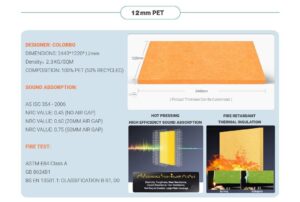
Product density and thickness
Sound absorption performance
Environmental certifications and relevant compliance documents
Production capacity and batch-to-batch consistency
OEM/ODM customization capability
For engineering projects in particular, suppliers should be able to provide test documentation corresponding to the actual product specification being supplied. This helps buyers complete technical evaluation during project bidding, material approval and procurement.
5. Why Does Flame-Retardant Technology Matter in Acoustic Panel Procurement?
In hotels, offices, commercial spaces, public buildings and other interior environments, polyester fiber acoustic panels serve both acoustic and decorative functions. At the same time, the material may need to comply with specific fire-performance requirements depending on the project and local regulations.
Therefore, professional buyers should evaluate the complete product package, including raw materials, manufacturing process, flame-retardant performance, acoustic performance, product consistency and compliance documentation, rather than focusing on price alone.
Working with a manufacturer that has stable production capabilities and systematic quality control can help importers, distributors and project contractors maintain consistent product quality and simplify technical verification.



Looking for Flame-Retardant Polyester Acoustic Panels?
If you are sourcing flame-retardant polyester fiber acoustic panels for commercial interiors, hospitality projects, offices or other architectural applications, we can provide product specifications, samples and relevant test documentation for your evaluation.